Real Car Driving Midnight Club
- 4.6
- Rating
- 50.00M
- Installs
- Free
- Price
 Analysis by App-foxy
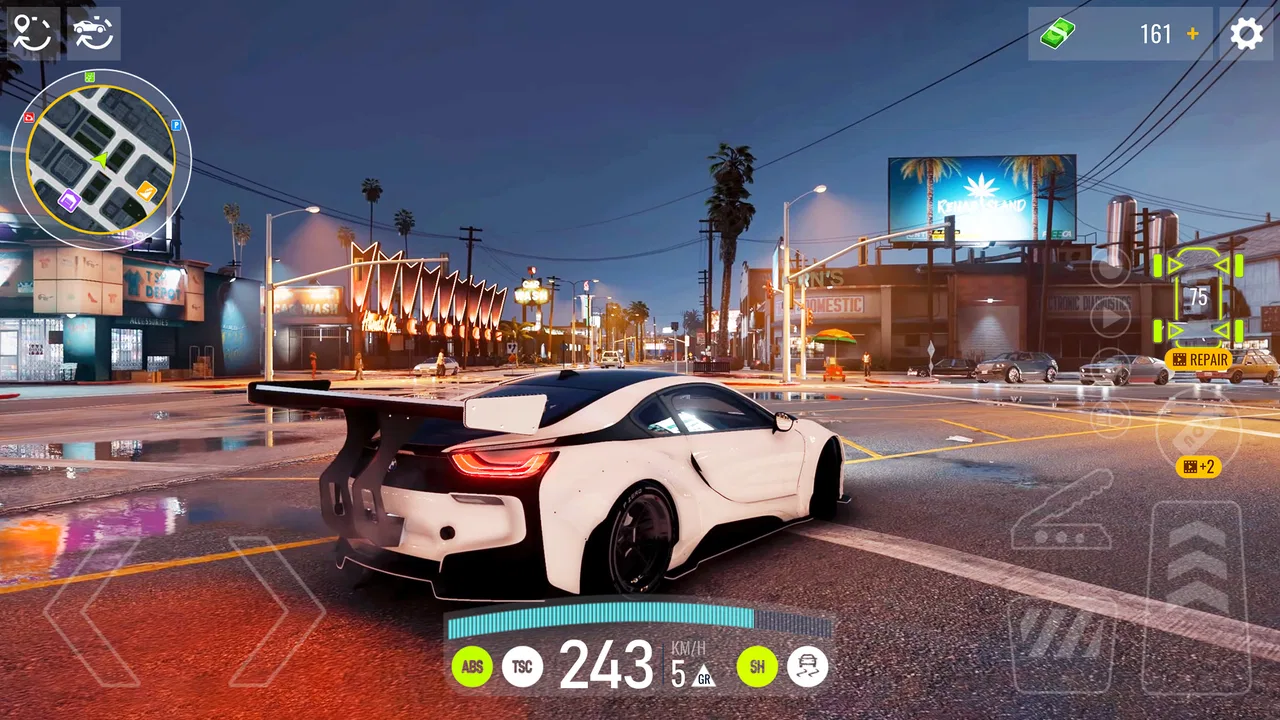
Real Car Driving Midnight Club is the kind of racing game I open when I want to drive rather than manage a complicated career. Its appeal is immediate: an open-world city, road traffic, quick bursts of speed, and enough freedom to make a short session feel worthwhile. I would not call it a complete replacement for a polished console-style racer, but I do think it succeeds as a free mobile driving game with a clear focus on cruising and fast street runs.
My overall view is simple: this is at its best as a pick-up-and-play city driving game. It gives me room to experiment, practise control, and enjoy the sensation of moving through an urban environment without demanding a long commitment every time I play. The trade-off is that players looking for deep simulation, a carefully structured championship, or a highly refined competitive system may find the experience less satisfying.
What the driving experience gets right
I find the open city most rewarding when I give a drive a small purpose: scout a route, practise a tricky turn, or see how smoothly I can handle traffic without rushing. That approach makes the freedom feel deliberate rather than aimless, and it helps me judge the touchscreen controls at a comfortable pace. The next section looks at the moments when that same freedom can start to feel less engaging.
You May Also Like

 Blood Strike: 2.5 Anniversary
Blood Strike’s Loadouts Turn Every Drop Into a Tactical Gamble
A close look at Blood Strike’s custom loadouts: how fast access to signature weapons reshapes its battle royale rhythm, rewards preparation, and narrows the gap between fights.

 Pandora - Music & Podcasts
Pandora’s Music Is Easy to Start, but Harder to Recover
Pandora’s strength is its low-effort path from a seed to a station. Its weak spot is how much confidence it asks you to place in connection, setup, and quiet recovery.

 8 Ball Pool
 Is Built on Rivalries, Rematches, and Routine
A close look at the rivalries, rematches, shared routines, and unanswered safety questions that turn a quick pool match into a persistent mobile community.

 Samsung Music
’s Quiet Strength Is Playing What You Already Own
Its reach comes less from spectacle than from dependable access to a personal library. That simplicity is both the app’s strongest retention engine and its ceiling.

 AccuWeather: Weather Radar
AccuWeather Review: A Quick, Clear Forecast for Everyday Decisions
For everyday plans, the best forecast is the one you can understand quickly. AccuWeather makes rain timing, radar, and local conditions easy to act on, with a few trade-offs.

 Hill Climb Racing
Why Hill Climb Racing Still Turns Crashes Into One More Run
A tiny car, a bumpy hill and one more upgrade: Hill Climb Racing keeps resurfacing because its simple chaos makes every near-miss feel personal.
More From Our News Desk
View All News


A city that makes short sessions feel useful
The open-world setting is the main reason I keep coming back. Instead of loading into one isolated race after another, I can spend a few minutes simply driving around, learning the roads, testing how the car responds, and deciding what I want to do next. That works particularly well on a phone because a session does not have to become a major event. I can play during a short break, take a few runs through the city, and stop without feeling that I abandoned a long campaign.
That freedom also changes how I judge mistakes. In a conventional track racer, missing a corner can ruin an entire attempt. Here, a wrong turn or awkward collision is less frustrating because the city remains available and I can quickly get moving again. For me, that makes the game more approachable than racers that put too much pressure on perfect laps.
The setting is also useful for practising. I can repeat a difficult stretch of road, try a different line through traffic, and gradually become more comfortable with steering and speed control. This is one of the less obvious strengths of an open-world racer: it gives me a place to learn naturally rather than forcing every lesson into a formal tutorial.
Controls that suit a touchscreen
Touchscreen driving always involves compromise. Physical buttons and a controller offer more precise feedback, while a phone screen can feel vague when several actions happen at once. Real Car Driving Midnight Club works best when I treat it as an accessible driving game rather than a strict simulation. The controls are easier to enjoy when I make smooth inputs instead of constantly tapping or dragging in panic.
I found that short, deliberate steering movements were more dependable than large corrections. That matters in city traffic, where an overreaction can send the car into another vehicle or away from the line I intended to take. New players should spend their first few minutes learning the relationship between steering input and road position before chasing speed. It is a small adjustment, but it makes the whole game feel less slippery.
Another practical tip is to avoid judging the game during the first chaotic drive. Urban roads can make every control system feel worse than it is because there are too many distractions at once. I get a better impression by starting slowly, following the road, and then increasing speed once I know how much space the car needs to turn and stop.
Why the free model is attractive
The game is free to download, which makes it easy to recommend as a low-risk experiment. I can try the driving style before deciding whether it deserves a permanent place on my phone. The optional purchases range from $0.99 to $19.99 per item, so anyone who enjoys the game should remember that the free entry point and the full spending experience are not the same thing.
That distinction is important for younger players and for anyone sharing a device. The Teen content rating is a useful reminder to check purchase settings before handing the phone to someone else. I would personally begin without buying anything, learn how much enjoyment the basic experience provides, and only then decide whether an optional purchase genuinely improves my sessions.
For a free racing game, the strongest value is not necessarily the amount of content I can unlock. It is the fact that I can use the city as a casual driving space without first paying an entry fee. That makes it more inviting than premium alternatives for curious players, although players who dislike in-app purchase systems may prefer a paid game with a clearer one-time cost.
Useful ways to play beyond simply going fast
The obvious approach is to push the car as hard as possible, but that is not always the most enjoyable one. I get more from the game when I alternate between three kinds of sessions: relaxed exploration, control practice, and speed-focused driving. Exploration helps me understand the city. Practice helps me improve consistency. Speed runs give me the excitement that brought me to a racing game in the first place.
This rotation also reduces repetition. If I only chase maximum speed, traffic and mistakes can make the game feel noisy. If I only cruise, I may miss the tension that gives the racing category its energy. Switching goals keeps the same environment feeling more flexible, especially when I have only a few minutes available.
A second useful habit is to treat the first run through an unfamiliar area as reconnaissance. I watch for turns, changes in road width, and places where traffic leaves little room for correction. On the next attempt, I can focus on a cleaner line instead of reacting to every obstacle. That process gives the open world a purpose beyond decoration.
I also recommend playing with a specific personal target rather than an undefined goal. For example, I might try to complete a city loop without a collision, maintain a steady pace through a busy section, or improve one difficult turn. These goals are not formal statistics I need to chase; they are simple ways to create structure when I want more than free driving.
Where the experience loses momentum
I enjoy the game’s casual pace, but it can lose its pull when I want a clear next objective or a more focused test of driving skill. Traffic and touch input can also make a fast run feel untidy, so I get more satisfaction from measured steering than from constant aggression. The next section considers those friction points and the kinds of players who may prefer a more structured racer.
Freedom can feel less focused than a traditional racer
The same open-world design that makes the game convenient can also make it feel directionless. When I want a clear sequence of races, a strong sense of progression, or a reason to master one particular track, an open city is not always enough. I can enjoy roaming for a while and still wish the game gave me a more compelling next objective.
This is the main weakness in the experience for me. The city provides space, but space alone does not guarantee variety. If your ideal racing game is built around tightly designed circuits, visible improvement, and a campaign that steadily raises the stakes, a more traditional track racer may be a better fit. Real Car Driving Midnight Club is much more comfortable with informal play than with a carefully staged competitive journey.
That does not make the open world a failure. It simply means the game asks me to supply some of the motivation. I have to decide whether I am exploring, practising, or chasing speed. Players who enjoy setting their own goals may see that as freedom; players who want constant direction may experience it as a lack of focus.
Traffic and touch controls demand patience
City driving creates exciting near-misses, but it also produces moments that feel messy rather than skillful. A crowded road can leave little room to recover from a small steering error. On a touchscreen, that can be especially noticeable because I do not receive the same physical feedback I would get from a controller. When I am trying to drive aggressively, the difference between a controlled correction and an accidental swerve can feel narrow.
The best response is to drive with a margin of safety. I leave more room around other cars, slow slightly before tight turns, and avoid making several large inputs at once. That may sound less dramatic, but it produces cleaner runs and makes the game more enjoyable. The experience rewards restraint more than a player might expect from a title built around speed.
There is also a device-related trade-off. The game supports Android devices from version 8.1 onward, which gives it a broad potential audience, but phones vary widely in screen size, responsiveness, and performance. I would not assume that every device will offer exactly the same comfort. A larger screen may make the city easier to read, while an older phone may make a fast session feel less pleasant than a newer one.
What the numbers suggest, and what they do not guarantee
The game has built a substantial audience, with over 50 million installs and a 4.7 average from around 61 thousand ratings. Those figures tell me that the basic idea has reached many players and that the overall reception is strong. They are encouraging, but they do not remove the need to decide whether this particular style of driving suits me.
The current release is version 1.8.6, and the game comes from Zendios. It was released on October 31, 2024, so I see it as a relatively recent mobile racing option rather than an old title surviving only through familiarity. Still, popularity cannot solve the central design question: do I want an open city for self-directed driving, or do I want a more structured racing package?
I would also keep expectations realistic about the rating. A high average can reflect how much players enjoy quick, accessible driving, while a dedicated racing fan may judge the game by deeper standards. The right conclusion is not that the game is universally excellent. It is that many players find its particular balance of free driving and arcade-style action appealing.
Who should install it
I think it is a good match for someone who wants a free racing game that can be enjoyed in short bursts. If you like entering a city, driving for a while, and creating your own challenge, the open-world format gives you useful freedom. It is also a sensible choice for newcomers who are not ready for a demanding simulation and want to become comfortable with mobile driving controls first.
It suits casual players especially well in everyday situations. Imagine having ten minutes before an appointment: I can start the game, make a few runs through the city, practise one turn, and close it without needing to complete a long event. That kind of flexibility is more valuable than it sounds. Many mobile games are designed around extended progression, while this one can provide entertainment even when I have no time to settle in.
I would be more cautious about recommending it to someone who wants realistic vehicle behaviour, detailed tuning, serious online competition, or a tightly organised championship structure. Those players may prefer a simulator or a premium racing game with more deliberate progression. I would also suggest skipping it if you strongly dislike in-app purchases, because the free model includes optional items that can change how you think about the game’s value.
Parents should pay attention to the Teen rating and purchase controls before allowing younger family members to play. The rating does not automatically make the game unsuitable for every teenager, but it is a useful prompt to consider the player’s age and the way purchases are handled on the device.
How it compares with familiar alternatives
Compared with a conventional circuit racer, this game gives me more freedom and less pressure to follow a fixed route. That makes it better for relaxed exploration and spontaneous driving, but weaker when I want a clear competition loop. A track-focused alternative will usually feel more purposeful because every corner has an obvious role in the race. Here, the city is the main playground, and I must create more of the challenge myself.
Compared with a serious driving simulator, Real Car Driving Midnight Club is easier to approach. I can focus on movement, traffic, and speed without treating every input like a technical exercise. The cost of that accessibility is depth. Players who enjoy carefully reproducing real driving behaviour may find the experience too forgiving or too informal, while players who want immediate action may appreciate exactly that simplicity.
Compared with other free mobile racers, its strongest distinction is the open-world emphasis. Many alternatives are built around menus, event selection, and repeated races. This game is more appealing when I want the road itself to be the activity. The compromise is that free exploration can become less satisfying if I need constant rewards, new objectives, or a strong narrative reason to keep playing.
My practical recommendation before spending
I would begin by playing several sessions without making a purchase. Use the first session to learn the controls, the next to explore, and another to test whether the city remains enjoyable once the novelty wears off. This approach answers the most important question better than any rating: whether I personally enjoy making my own goals in the open world.
If the game feels good but the controls seem difficult, I would adjust my driving style before blaming the app. Smooth steering, earlier braking, and a slower first pass through unfamiliar roads can make a significant difference. If the game still feels unfocused after that, the problem is probably not technique; it is a mismatch between the open-world design and what I want from racing.
For players considering an in-app purchase, I would ask whether it changes a recurring part of the experience or merely provides a short burst of novelty. Since individual items can cost from $0.99 to $19.99, setting a personal limit in advance is sensible. The free version is the right place to decide whether the driving itself is strong enough to justify spending.
Final verdict
Real Car Driving Midnight Club is a convincing casual open-world racing game with a clear identity. I enjoy it most when I use the city as a flexible driving playground, set a small personal challenge, and accept that the game is more about immediate movement than a deep racing career. Its approachable entry point, broad device support from Android 8.1 onward, and large player base make it easy to try.
Its limitations are equally clear. The open world can feel under-directed, touchscreen driving requires patience, and the free-to-play structure deserves attention before anyone spends money. It is not the choice I would make for serious simulation or a tightly designed championship. For those needs, another kind of racer will serve better.
For everyone else, I think the recommendation is worthwhile: install Real Car Driving Midnight Club if you want quick city driving, flexible short sessions, and the freedom to make your own fun. If you prefer a more structured experience, choose a track-based alternative instead. In my view, the game earns its place not by trying to do everything, but by making casual open-world driving easy to start and enjoyable to return to.
My final judgement is positive but specific. Choose it for freedom and convenience, not for simulation depth or a fully guided racing campaign. That expectation matches what the game does best and avoids the disappointment that comes from asking it to be a different kind of racer.
FAQs for Real Car Driving Midnight Club
01What is Real Car Driving Midnight Club about?
Real Car Driving Midnight Club is a high-octane racing game that immerses players in a vibrant urban environment. It offers realistic driving mechanics, a variety of customizable cars, and exciting missions. Whether you're racing against AI opponents or exploring the open-world city, the game promises an exhilarating experience for car enthusiasts.
02What are the key features of Real Car Driving Midnight Club?
The game boasts a range of features including a vast selection of cars, detailed customization options, and stunning graphics. Players can engage in thrilling races, explore an expansive open-world city, and complete various challenges. Real-time multiplayer mode adds a competitive edge, allowing players to race against friends or other online players.
03Is Real Car Driving Midnight Club free to play, and are there in-app purchases?
Real Car Driving Midnight Club is free to download and play, offering a substantial amount of content without any cost. However, it does include in-app purchases for players who wish to enhance their gameplay experience by unlocking premium cars, customization options, or other exclusive features. These purchases are optional and not necessary to enjoy the game.
04What devices are compatible with Real Car Driving Midnight Club?
The game is available for both Android and iOS devices. It requires a device running Android 5.0 or later, or iOS 10.0 or later. It's optimized for most modern smartphones and tablets, ensuring smooth gameplay and high-quality graphics. Users should ensure their device has the latest updates for optimal performance.
05How can players improve their skills in Real Car Driving Midnight Club?
Players can improve their skills by regularly practicing different racing techniques and learning the city's layout. Participating in various missions and challenges helps in understanding the mechanics better. Additionally, experimenting with car customizations can enhance performance, giving players a competitive edge in races. Joining online communities can also provide valuable tips and strategies.
Pros
- Stunning graphics with realistic car details.
- Extensive car customization options available.
- Seamless online multiplayer races.
- Intuitive controls for smooth gameplay.
- Regular updates with new content.
Cons
- Occasional in-app purchase prompts.
- Some tracks feel repetitive over time.
- Requires a stable internet connection.
- Battery drains quickly during gameplay.
- Limited offline features available.

Real Car Driving Midnight Club
Gallery